 Australia Important Bird Area
Prince Regent and Mitchell River Important Bird Area
49 bird species recorded; the most in July.
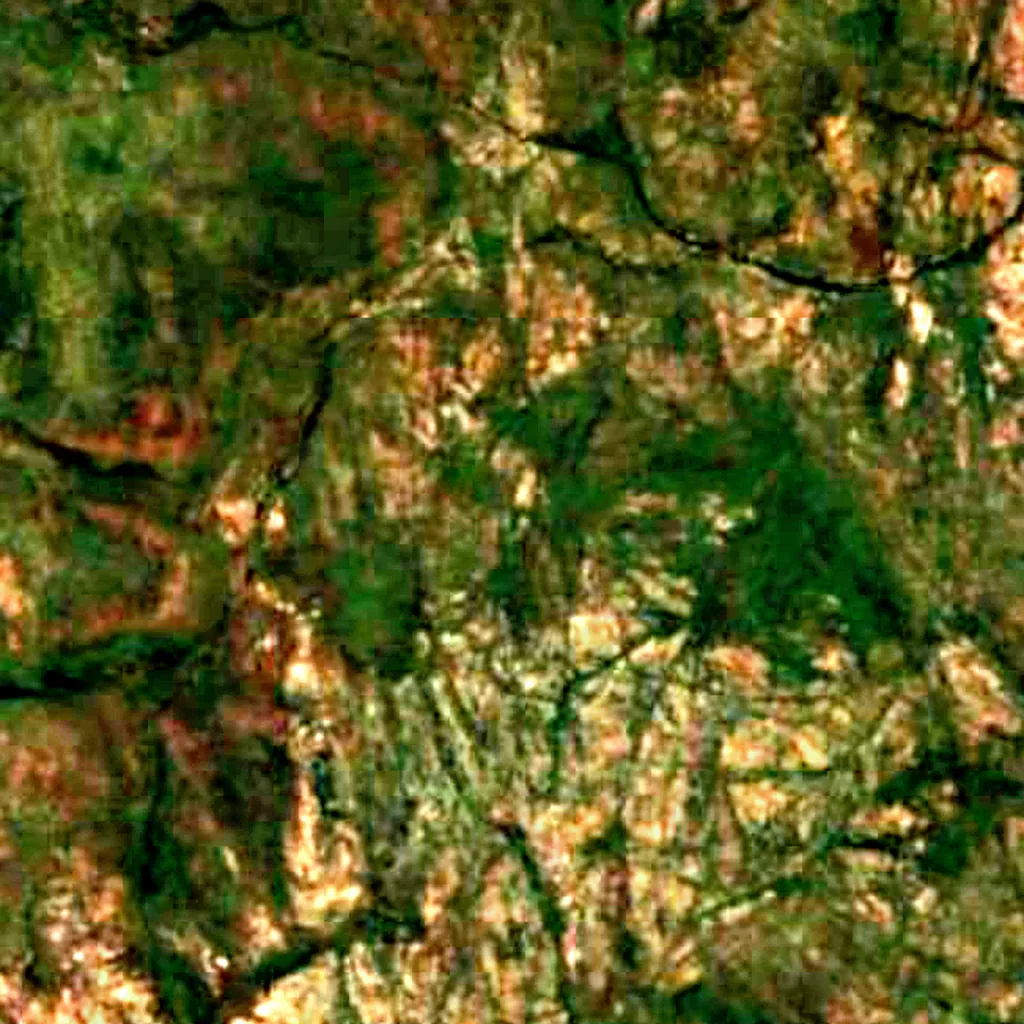
Sentinel-2 cloudless 2016 by EOX IT Services GmbH (contains modified Copernicus Sentinel data), CC BY 4.0, with relief shading from Copernicus WorldDEM-30
This month here
0 species in January.0 species in February.0 species in March.0 species in April.0 species in May.0 species in June.48 species in July.42 species in August.0 species in September.0 species in October.0 species in November.0 species in December.
The birds you are most likely to see in the month you choose, those that come for the season first. It opens on today's month.
No records for this month.
No records for this month.
No records for this month.
No records for this month.
No records for this month.
No records for this month.
No records for this month.
No records for this month.
No records for this month.
No records for this month.
No records for this month.
No records for this month.
- Resident all year
- Summer visitor comes to breed
- Winter visitor comes for the winter
- Passage migrant in spring and autumn
In numbers
49 species, counted.
Our own rating, from the records only: species (50 points), threatened species (20), migrants (20) and protected status — Ramsar, IBA, SPA, observatory (10).
- 49Speciesrecorded more than once
- 0Migrantssummer, winter or passage visitors
- 0ThreatenedVulnerable, Endangered or Critically Endangered (IUCN)
- 194Recordsopen records within 15 km
- 334 mAltitudeabove the sea
- 2Raptors
- 1Owls
- 3Waders
- 2Gulls & seabirds
- 10Herons, ibises & grebes
- 1Storks & cranes
- 22Songbirds
- 8Other birds
From open records (eBird and others, through GBIF, licensed for any use). More birdwatchers mean more records: a quiet place may have more birds than it shows.
The checklist
All 49 species.
By group, with the year in twelve cells: the darker the cell, the more often the bird is recorded that month.
Raptors2 species
- Whistling KiteHaliastur sphenurus
- Brown FalconFalco berigora
Owls1 species
- Barking BoobookNinox connivens
Waders3 species
- Eurasian WhimbrelNumenius phaeopus
- Far Eastern CurlewNumenius madagascariensis
- Common SandpiperActitis hypoleucos
Gulls & seabirds2 species
- Lesser Crested TernThalasseus bengalensis
- Great Crested-TernThalasseus bergii
Herons, ibises & grebes10 species
- White-faced HeronEgretta novaehollandiae
- Striated HeronButorides striata
- Nankeen Night HeronNycticorax caledonicus
- Reef HeronEgretta sacra
- Oriental DarterAnhinga melanogaster
- Australian PelicanPelecanus conspicillatus
- Little Pied CormorantMicrocarbo melanoleucos
- Great White EgretArdea alba
- Little EgretEgretta garzetta
- Pied CormorantPhalacrocorax varius
Storks & cranes1 species
- BrolgaGrus rubicunda
Songbirds22 species
- Golden-headed CisticolaCisticola exilis
- White-throated HoneyeaterMelithreptus albogularis
- Sandstone Shrike-thrushColluricincla woodwardi
- Torresian CrowCorvus orru
- MistletoebirdDicaeum hirundinaceum
- WeebillSmicrornis brevirostris
- Leaden FlycatcherMyiagra rubecula
- Black-faced CuckooshrikeCoracina novaehollandiae
- White-bellied CuckooshrikeCoracina papuensis
- Bar-breasted HoneyeaterRamsayornis fasciatus
- Silver-crowned FriarbirdPhilemon argenticeps
- Brown HoneyeaterLichmera indistincta
- Red-backed FairywrenMalurus melanocephalus
- Olive-backed OrioleOriolus sagittatus
- Double-barred FinchTaeniopygia bichenovii
- Great BowerbirdChlamydera nuchalis
- Long-tailed FinchPoephila acuticauda
- Willie-wagtailRhipidura leucophrys
- Northern FantailRhipidura rufiventris
- Australasian FigbirdSphecotheres vieilloti
- White-gaped HoneyeaterStomiopera unicolor
- Yellow-tinted HoneyeaterPtilotula flavescens
Other birds8 species
- Brown QuailSynoicus ypsilophorus
- Rainbow Bee-eaterMerops ornatus
- Blue-winged KookaburraDacelo leachii
- Little CorellaCacatua sanguinea
- Red-tailed Black CockatooCalyptorhynchus banksii
- Peaceful DoveGeopelia placida
- White-quilled Rock-PigeonPetrophassa albipennis
- Pheasant CoucalCentropus phasianinus
Monthly presence relative to all bird records that month, so a busy month does not inflate every species.
When to go
The most species in July.
Species recorded in each month, with the usual temperature and rain.
- Jan30°/23°301 mm
- Feb30°/23°265 mm
- Mar30°/22°212 mm
- Apr31°/20°41 mm
- May30°/17°18 mm
- Jun30°/15°7 mm
- Jul31°/15°2 mm
- Aug33°/16°1 mm
- Sep37°/20°3 mm
- Oct38°/22°37 mm
- Nov37°/24°86 mm
- Dec33°/24°216 mm
- Bar: species recorded that month.
- Temperature: average maximum / minimum (NASA, 1991–2020).
- Rain: monthly total.
The place
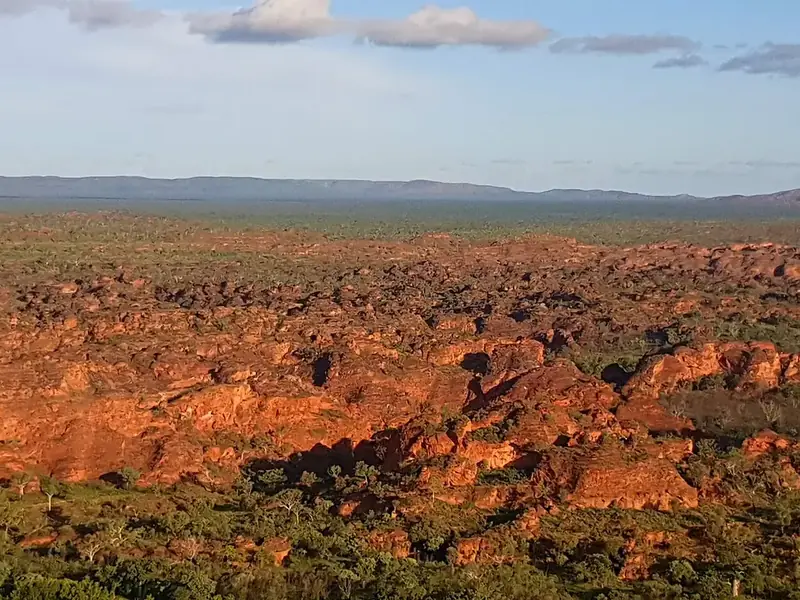
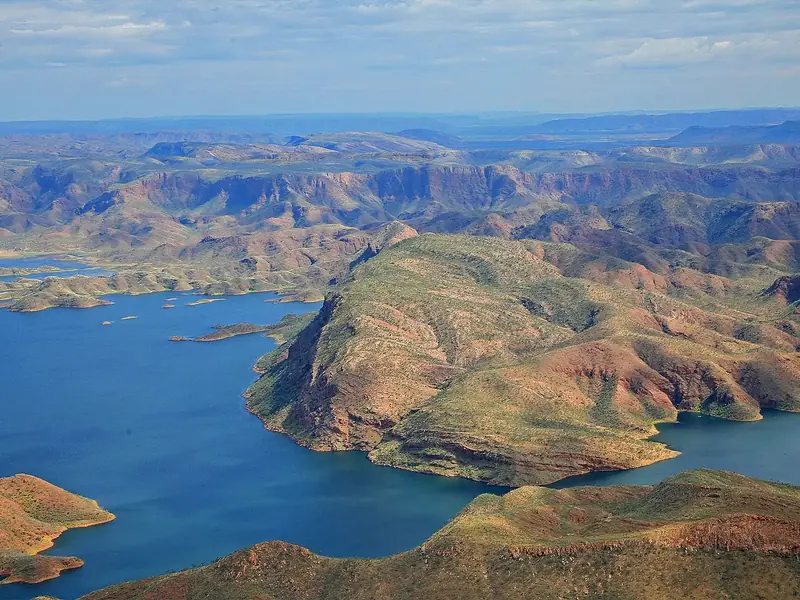
Prince Regent and Mitchell River Important Bird Area.
Important Bird Area in Western Australia
Prince Regent and Mitchell River Important Bird Area is an Important Bird Area (BirdLife) in Australia, 334 m above the sea.
49 bird species have been recorded here more than once, in 194 open records.
The most recorded are the White-faced Heron, the Striated Heron and the Nankeen Night Heron.
The most species are recorded in July.
Get there and watch
- Fitzroy Crossing Airport (FIZ)nearest airport with scheduled flights · 312 km in a straight lineCar hire at KNX airport (Kununurra)Discover Cars · sponsored link↗
Plan the visit
A guided walk, a bed nearby, a car.
Some links above are affiliate links: if you book through them we may earn a commission, at no extra cost to you. It never changes what the data on this page says.
From above
The place and its surroundings.
The satellite image of the 6 × 6 km around the place, with the bird hides, towers and trails that OpenStreetMap shows.
Around, in OpenStreetMap
- bird hides within 6 km
- observation towers within 6 km
- marked trails within 4 km
- visitor centres within 6 km
- viewpoints within 5 km
- car parks within 3 km
- restaurants and cafés within 3 km
- campsites within 10 km
- places to stay within 10 km
Counted in OpenStreetMap, the map anyone can edit. A low number may just mean nobody has mapped it yet.
In our other atlases
Around Prince Regent and Mitchell River Important Bird Area.
The lakes, beaches, islands, rivers and mountains around this place, and its night sky, in the family's atlases.
 Peakyas3 mountains within 25 km
Figures from the sister sites' databases (Wikidata, HydroATLAS, GeoNames, OpenStreetMap). Links open when each site is online.
Other places nearby.
Prince Regent and Mitchell River Important Bird Area
Australia
- 34Birdyas Score
- 49Species
- 0Migrants
- 0Threatened

Where these figures come from
| Name and type | Wikidata (Q7244209) · CC0 |
|---|---|
| Birds | 194 open bird records within 15 km (GBIF, CC0 and CC BY 4.0 only; mostly eBird, Cornell Lab of Ornithology) |
| See these records | gbif.org |
| Species | GBIF Backbone Taxonomy · CC BY 4.0; Wikidata (CC0); Wikimedia Commons |
| Altitude | Copernicus DEM GLO-30 · © DLR e.V., © Airbus Defence and Space GmbH, Copernicus/ESA |
| Temperature and rain | NASA POWER (CERES SYN1deg, 2001–2020; MERRA-2) |
| What is around | © OpenStreetMap contributors · ODbL |
| Images | EOX Sentinel-2 cloudless 2016 · CC BY 4.0; Wikimedia Commons |
| Sister atlases | Peakyas |
Every figure is an average, an estimate or a count from a public dataset. Licences and methods: data sources.
The family
Do you prefer beaches, lakes, mountains, waterfalls, islands, rivers, canyons, caves, dark skies, viewpoints, birdwatching or forests?
Same idea, other landscapes: field atlases built on open data, in seven languages.
 beaches
 Find your beach: sea temperature, sun and swimming month by month.Visit
  lakes
lakes Every lake on Earth: water temperature, ice, depth and the shore.Visit mountains
 Every summit in 3D: summit weather, the 0 °C line, huts and trails.Visit
  waterfalls
 Every waterfall: height, flow month by month and when it roars.Visit
  islands
 Every island from the sea up: size, sea temperature, ferries and 3D.Visit
  rivers
 Every river from source to sea: the journey, the flow and the basin in numbers.Visit
  canyons
 Every canyon cut to scale: depth to the floor, rim and floor temperatures, trails and viewpoints.Visit
  caves
caves Every cave with its real depth and length: the rock above, the temperature inside all year, and how to visit.Visit
  dark skies
 Where the night is still dark: the sky of every place, the Milky Way month by month, the Moon, eclipses and auroras.Visit
  viewpoints
 Every viewpoint with its real 360° panorama: the peaks you can name, how far you see and where the sun sets.Coming soonVisit
  birdwatching
 Every bird sanctuary and wetland with the species recorded month by month: who is resident, who comes for the summer, who only passes through.You are here
 forests
 Every forest with its land-cover rings, what grows and lives in it, and the best months to walk it.Coming soonVisit